
AI receptionist vs a human receptionist: the honest 2026 comparison
AI receptionist vs human receptionist: a sourced 2026 comparison of cost, coverage, and the calls each handles best — and why most businesses run both.

Most articles with this title were written by whoever is selling the AI. This is the honest version — from people who build the AI, and who will still tell you, plainly, when a human wins. Because on a good number of calls, a human does.
This is a real decision now, not a thought experiment. US small-business adoption of AI rose from 39% to 55% in a single year, and voice AI now handles close to a fifth of inbound contact-centre volume, up from six percent in 2024. The technology crossed a line recently. The question deserves a real answer — so here is one, with the numbers attached.
What a human receptionist actually costs
Start with the salary, because every comparison does. US Bureau of Labor Statistics data puts the median receptionist wage at $17.90 an hour — around $37,000 a year. That number is real, and it is also not the cost.
The cost is fully loaded. Benefits add nearly 30% on top of wages, by the BLS’s own measure of employer compensation. Payroll tax adds another 7.65%. Then there is paid time off that still needs covering, a workstation, software, and the recruiting itself. Add it honestly and one daytime receptionist costs somewhere between $48,000 and $62,000 a year. And front-desk roles turn over often — somewhere around a third of post-holders leave each year — so a slice of that recruiting cost recurs whether you planned for it or not.
The hours nobody counts
Here is the part most comparisons skip. A single full-time hire covers about 2,000 working hours a year. A year has 8,760 hours. That is roughly a fifth of the clock — and it is the easy fifth. Nights, weekends, public holidays, the lunch hour, and the second caller who rings while your receptionist is already on the line: none of that is covered by one salary. Genuine round-the-clock human coverage is not one person. It is three, realistically four once you account for leave — $150,000 to $200,000 and up, every year.
What an AI receptionist costs
A capable AI receptionist — one that answers, books, qualifies and logs every call — runs roughly $150 to $300 a month for most small businesses — though what actually drives a voice agent’s price is worth its own breakdown. That is $1,800 to $3,600 a year, with 24/7 coverage and unlimited simultaneous calls included rather than charged for. A live human answering service sits in between: $200 to $600 a month, but billed by the minute, with overage rates and after-hours premiums that quietly push the real figure higher than the advertised one.
The cost gap is real and large — but the fair comparison is not “AI versus one part-time hire.” It is AI against the round-the-clock coverage you would otherwise need three or four people for. Lined up that way, the AI is not a little cheaper. It is a different order of magnitude — and that is precisely why the decision is not really about money.
Where the AI genuinely wins
The AI’s strengths are real, and they cluster around one idea: the call that happens the same way, over and over, at any hour.
- It never misses a call. It answers in under two seconds — at 2am, during the lunch rush, and on the twelfth simultaneous call as easily as the first.
- It is perfectly consistent. The same greeting, the same questions, the same details captured on call five hundred as on call one — no off days.
- It is genuinely good at routine work, understanding and booking a scheduling request with accuracy in the 90–95% range.
- It speaks the caller’s language — several languages out of the box, with no second hire.
Where the human still wins — and it is not close
A grieving caller. A medical worry. A furious client mid-escalation. None of these is a routine call, and the receptionist who hears the unspoken thing — and knows what to do with it — is doing something an AI cannot. The 2026 voice models are good at detecting emotion; independent benchmarks put them around 85–90% accurate at hearing it. But detecting an emotion and genuinely meeting it are different skills, and only one of them is human.
It shows in the resolution numbers. The AI handles routine bookings well — but on complex complaints and disputes, its resolution rate falls to somewhere between 10 and 25%. The hard calls, the ones a customer remembers, are exactly the calls it cannot finish on its own.
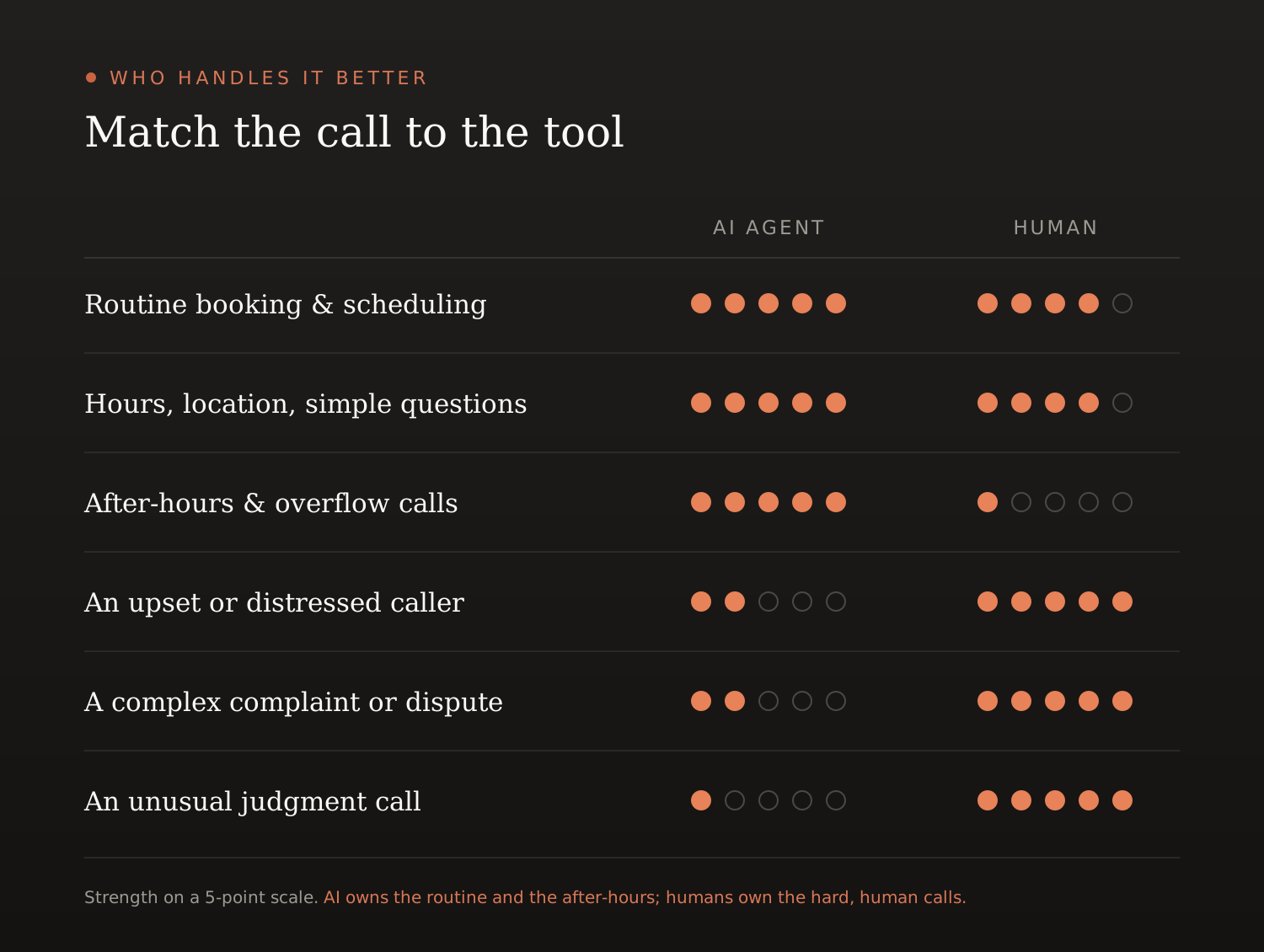
And then there is plain preference. In a December 2025 survey of more than two thousand US adults, 79% said they strongly prefer a human over an AI agent. The technology has improved faster than how people feel about it — and on the calls that matter most to a customer, that feeling is worth respecting rather than arguing with.

An AI receptionist is not a cheaper person. It is a different tool — superb on the routine call, wrong for the hard one. Buy it as a tool, not a replacement.
How good is the AI, really, in 2026?
It is worth being precise here, because most people’s intuition is a year or two out of date. The thing that changed is latency. Natural human conversation leaves a gap of 200 to 300 milliseconds between turns; until recently AI voice could not come close, and that lag was the tell — the small, robotic pause that gave it away. In 2026 the best systems answer inside roughly that human window. On an ordinary business call, most people genuinely cannot tell.
It is not flawless. Heavy background noise, strong regional accents, and highly emotional callers still trip it up. And satisfaction scores reflect the split honestly: measured on its own, AI voice scores about 4.1 out of 5 against a human’s 4.3 — close, on routine work. In a hybrid setup, where the hard calls reach a person, that small gap all but disappears.
A 2024 test is not a 2026 product
If you tried an AI phone agent a year or two ago and it felt stilted and robotic, that judgement is genuinely out of date — voice is the part of this technology that moved the most. Before you decide anything, it is worth a fresh listen to a current one.
The answer most businesses land on: hybrid
Ask the people actually deploying this and the verdict is not close. When enterprise leaders are surveyed, 73% want a hybrid of AI and humans; only 6% want full automation. Nine in ten businesses plan to keep or grow their human teams alongside AI. The “robots replace everyone” framing is not what the buyers are choosing — they are choosing a division of labour.
- Let the AI own: after-hours and weekend calls, overflow when every human line is busy, routine booking and rescheduling, hours-and-location questions, and capturing a callback when it genuinely cannot help.
- Keep humans on: complaints and disputes, upset or distressed callers, high-value or unusual situations, and any caller who is really a relationship rather than a transaction.
The join between the two is the whole game. A good handoff carries the full context across — the human picks up already knowing who is calling and what was said — and it escalates early, on the first sign of frustration rather than the third. A handoff done badly undoes everything the AI got right in the first ninety seconds.
One legal thing to know first
If you deploy an AI voice agent, it generally has to tell callers it is AI. Disclosure rules — California’s AB 1018 and Florida’s HB 919 among them — require an AI voice to identify itself, usually within the first seconds of the call. It is a small thing to build in, and a real obligation to be aware of before you go live.
How to decide for your business
Skip the feature comparison and start with one number: in a typical week, how many inbound calls go unanswered? Across small service businesses, only about a third of calls are answered live; most of the rest reach voicemail, and roughly 85% of those callers never call back — they dial a competitor instead. After-hours is not a quiet fringe, either: close to a third of calls arrive outside business hours, and a large share of those callers are ready to buy. If your unanswered number is near zero, an AI receptionist is a convenience. For most growing businesses, it is nowhere near zero.
How we think about it at Zaibex
We build the AI side — the voice agent that answers your front desk — but the first thing we do is tell you, honestly, which of your calls should never go to a machine. The free discovery call and the free audit are built around exactly that: we look at your real call data — how many come in, when, how many are missed, and what kind they are — and map which calls the AI should own and which stay human, before you have spent anything at all.
