How much does an AI voice agent really cost in 2026?
What an AI voice agent really costs in 2026 — a line-by-line breakdown of build and running costs, and the line items most vendor quotes quietly skip.

Ask three voice-agent vendors what their service costs and you will get three numbers that do not agree — and not one that explains itself. One quotes five cents a minute. One quotes a flat monthly fee. One sends a proposal with a single line on it. None of them is lying. They are each showing you a different slice of the same bill.
It is worth getting this right, because voice agents are no longer a curiosity. The voice-AI market crossed twenty billion dollars in 2026, and roughly a third of US businesses with between ten and five hundred employees have either deployed one or are piloting one. The question for most owners is no longer whether to use a voice agent. It is what a good one actually costs — and how to read a quote without being quietly overcharged.
The headline rate is not the real rate
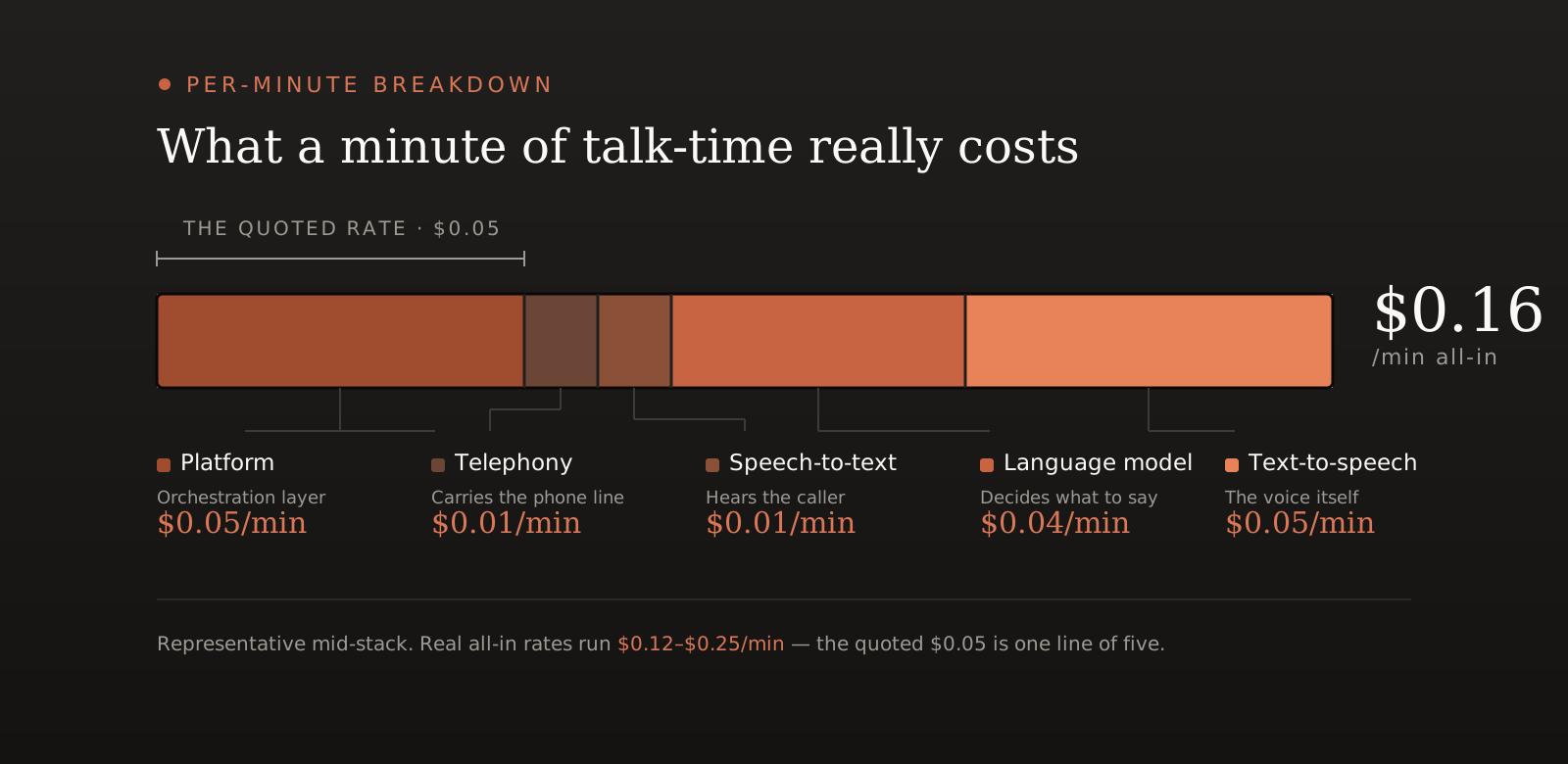
Every voice-agent platform leads with a per-minute number. Vapi advertises a platform fee of about five cents a minute. Retell starts around seven cents. Those numbers are real — and they are also the floor, not the price. They cover orchestration: the software that runs the call. They do not cover the phone line, the part that understands the caller, the model that decides what to say, or the voice that says it.
A five-cent-a-minute quote is true the way a car’s sticker price is true — accurate, and not what you drive away paying. The honest figure is built from layers, so the first thing worth doing is taking the layers apart.
What a minute of talk-time is made of
Unless a vendor bundles everything into one rate, a voice agent is assembled from a platform fee plus four moving parts. Each is metered separately, and each is billed for every minute of every call.
Telephony — the phone line
The call still travels over a real phone network. Through a provider like Twilio, an inbound minute to a local US number costs a little under a cent; a toll-free inbound minute is closer to two. The number itself rents for about a dollar a month. Small, predictable, and almost always passed straight through to you at cost.
Speech-to-text — hearing the caller
Before the agent can think, it has to transcribe the caller in real time. A streaming speech-to-text model — Deepgram’s Nova-3 is a common choice — runs around three-quarters of a cent per minute. It has to be the streaming kind: the cheaper batch transcription used for recordings cannot keep up with a live conversation.
The language model — deciding what to say
This is the agent’s brain, and the layer with the widest range. A fast, inexpensive model like GPT-4o-mini costs one to two cents a minute of conversation; a premium model can be four to six. There is also a quiet cost trap here: the agent’s instructions — its system prompt — are re-sent to the model on every single turn of the conversation, and charged every time. Prompt caching cuts that repeated cost by close to ninety-nine percent. A vendor not using it is overcharging you, and you would never see it on the invoice.
Text-to-speech — the voice itself
Finally, the agent’s reply has to be spoken aloud. A natural-sounding voice from a provider like ElevenLabs adds a few cents a minute — more for a premium or custom-cloned voice. On a four-minute call, retail text-to-speech alone is roughly forty cents; at scale that drops sharply.
Add the layers up and a typical, sensibly built voice agent costs somewhere between twelve and twenty-five cents per minute, all in. The optimistic floor is around seven cents; a premium-model, premium-voice configuration can pass thirty. The five cents you were quoted was always one line of five.
A worked example: 500 calls a month
Averages are easy to argue with, so here is a concrete one. Picture a single inbound line — an AI receptionist for a clinic, a trades business, or a law firm — handling 500 calls a month at about four minutes each. That is 2,000 minutes of talk-time. Built on a sensible mid-range stack, the monthly bill looks like this.
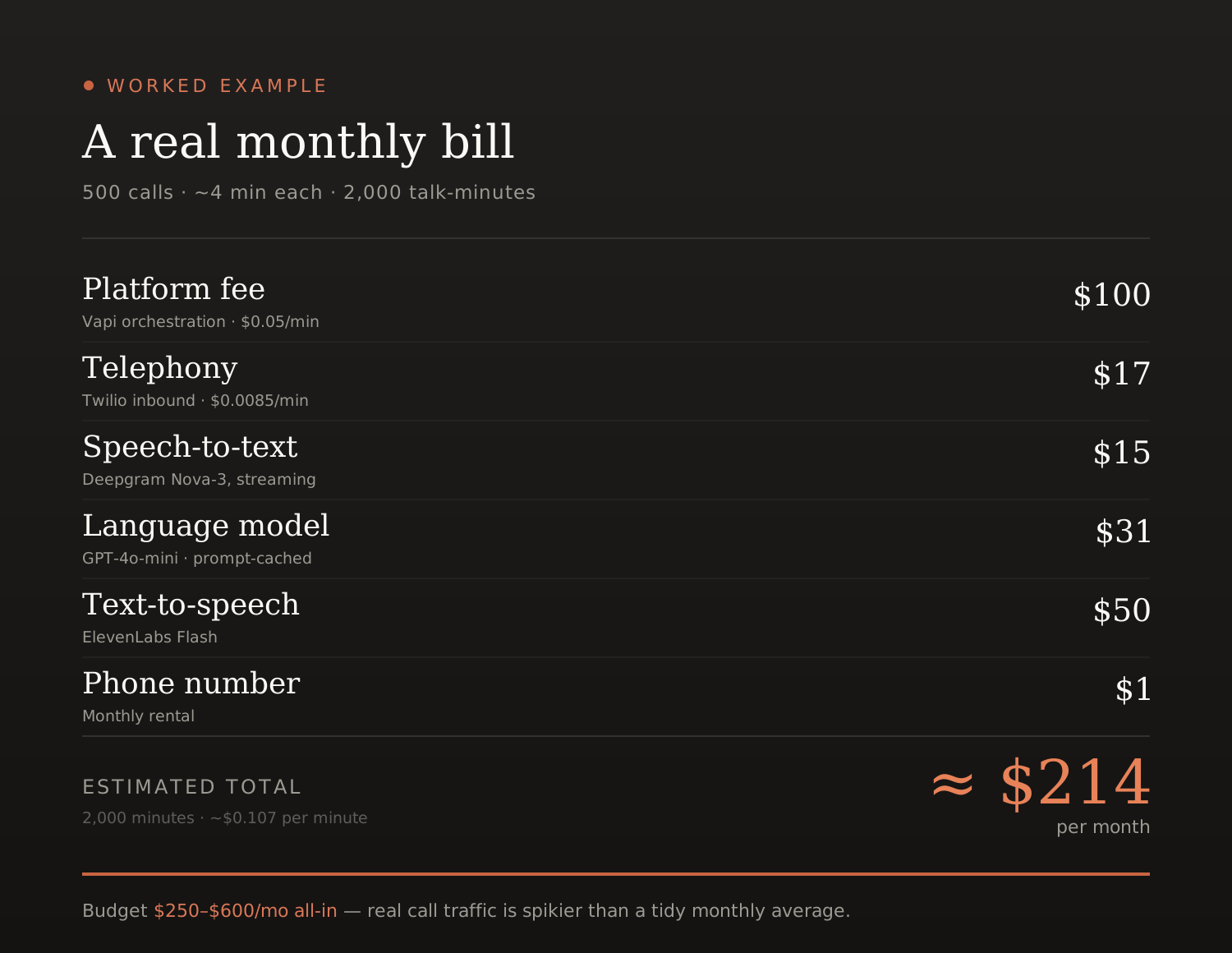
About $214 on paper. In practice, plan for $250 to $600 a month all-in. Real call traffic is spikier than a tidy average — busy seasons, longer calls, the occasional integration retry — and a buffer keeps the bill from being a surprise. A managed all-in-one product at the same volume tends to land in a similar range, with less to configure and less to tune.
The one-time cost: getting it built
Everything above is the running cost — the meter. Separate from it is the build: the one-time work of turning a blank platform into an agent that actually handles your calls. There are three honest routes, and the right one depends on how much the calls are worth.
- Do it yourself on a self-serve platform — $0 to a couple of hundred dollars in fees, but 20–40 hours of your own time on prompt design, testing and integration, and usually a rebuild once it meets real callers.
- Assisted setup from a managed vendor — roughly $500 to $2,000 to have someone configure the flows and train a knowledge base for you.
- A custom agency build — for a small or mid-sized business, realistically $2,000 to $8,000 for discovery, conversation design, calendar and CRM integration, telephony setup and proper testing.
- A full enterprise implementation — $10,000 and well up, once multi-system integration and compliance work are involved.
The do-it-yourself route looks free and rarely is. The 20 to 40 hours it takes are yours, and a voice agent built without conversation-design experience tends to get most callers most of the way and then fail the awkward ones — which are exactly the calls that were worth catching.
The line items quotes quietly skip
Beyond the build and the per-minute meter, a handful of costs rarely make the headline number. None of them is sinister. They are simply the parts a thin quote leaves out.
- Overage rates — pass an included cap and the per-minute rate jumps, often two to three times higher; some managed products bill several dollars per extra call.
- Concurrency fees — handling many calls at once costs extra per simultaneous line, even at the same total minutes.
- Integration fees — connecting a CRM, calendar or booking system that is not on the vendor’s supported list runs $1,000–$5,000.
- Setup and onboarding — $500–$2,000 for assisted configuration, even on self-serve products.
- Premium and custom voices — a small per-minute uplift, or a one-time fee in the low thousands for a cloned brand voice.
- Compliance add-ons — HIPAA-grade handling or zero-retention modes carry their own monthly fees, and they matter for medical, legal and financial callers.
A voice agent is not a one-time purchase. Price it like infrastructure — because a thing that answers your phone every day is exactly that.
The number that matters more than the price
It is easy to spend an afternoon comparing voice-agent quotes and never ask the only question that decides whether the agent is worth it: what is the current situation costing you? The honest comparison is not one vendor against another. It is the agent against the calls you are already losing.
Consider the alternative on its own terms. A full-time human receptionist, fully loaded with benefits and overhead, costs somewhere between $48,000 and $62,000 a year — and that buys a single shift. No nights, no weekends, no holidays, and no second receptionist for the call that arrives while the first is busy.
That is the real frame. A voice agent costing a few hundred dollars a month is not competing with a cheaper voice agent. It is competing with the missed calls, the after-hours silence, and the callers who reach voicemail and simply dial the next business on the list. Set the agent’s monthly cost beside the value of the calls it saves — and for most growing businesses the agent stops looking like an expense and starts looking like the cheapest salesperson on the team.
So what about ROI?
Payback periods reported for voice agents typically land between two and six months, with a common figure around three. Forrester’s commissioned research on voice-AI deployments has cited three-year returns in the hundreds of percent — credible, though worth reading as vendor-commissioned. The claim that survives a skeptic is narrower and stronger: an agent at $300–$600 a month that books even ten or fifteen extra calls — calls worth anywhere from $100 to several hundred dollars each, depending on your trade — has paid for itself many times over. That math holds because it rests on recovered revenue, not on hopeful labour savings.
How we price it at Zaibex
Every Zaibex voice-agent engagement is a fixed-scope build plus a monthly retainer that covers the platform and a defined usage ceiling. You see every layer written down on day one — no headline number with the moving parts hidden underneath, and no overage surprise at the end of a busy month. If you want the maths for your specific call volume, the discovery call is free and the audit that follows it is free: bring your traffic numbers and we will model the real figure with you, line by line, before anyone talks about a contract.

