
Why most AI projects fail — and how to de-risk yours before you spend
Why most AI projects fail in 2026 — what the research shows about the real causes, and a practical checklist to de-risk your AI project before you spend.

If you are about to spend real money on AI, there is one number worth sitting with first — and it is not a capability benchmark. It is the failure rate. The large majority of AI projects do not deliver what they set out to. Understanding why is the difference between joining them and not.
First, an honest word about the numbers, because they get thrown around carelessly. MIT’s 2025 study of enterprise AI found that 95% of organisations were getting no measurable return on their generative-AI spend. S&P Global found the share of companies abandoning most of their AI initiatives jumped to 42% in a single year, up from 17%. Gartner’s early-2026 survey of infrastructure leaders found that only 28% of AI use cases fully met their ROI expectations.
Those figures measure different things — “no profit-and-loss impact” is not the same as “abandoned” is not the same as “missed an ROI target” — so it is wrong to blur them into one terrifying number. But they come from independent research and they all point the same way, and the direction is not in doubt: spend money on AI carelessly and the odds are genuinely against you.
The failures are not technical — and that is the good news
Here is the part that should change how you feel about that. The research is consistent that most AI projects do not fail because the model could not do the work. The RAND Corporation interviewed 65 experienced AI engineers about why projects collapse, and four of the five root causes they identified are organisational, not technical. MIT’s diagnosis was the same: the barrier is not infrastructure, talent, or model quality — it is that tools get bought without being fitted to how the business actually works.
That is good news, because organisational problems are the ones you can fix before you spend a dollar. The model almost always works. The project around it is what was — or was not — built to succeed.
Failure mode one: starting with the technology, not the problem
RAND found the single most common cause of failure is a misunderstood or miscommunicated problem — the business and the engineers never actually agreed, in plain words, on what was being solved. Close behind it is a technology-first mentality: chasing the newest model instead of a defined, costly problem. “We should do something with agents” is not a project. “Our team spends nine hours a week re-keying orders between two systems, and here is what that costs us” is a project. Start with the second kind of sentence, or do not start.
Failure mode two: the data was never ready
An AI system is only as good as the data it works from, and most companies’ data is not ready for it. Gartner has found that roughly 63% of organisations either lack the data practices AI needs or do not know whether they have them — and predicts a large share of AI projects will be abandoned specifically because the data underneath them was never AI-ready.
“AI-ready” does not mean “big.” It means accessible rather than locked in disconnected silos; consistent rather than defined three different ways by three departments; complete rather than full of gaps; and governed. If the data your AI needs is not in that state, fixing it is the first project — not a footnote discovered halfway through the build, when it is expensive.
Failure mode three: the demo-to-production gap
This is the failure mode that fools people, because it feels like success. A demo answers the questions it was built to answer, in front of an audience that wants it to work. Production faces the question nobody anticipated — phrased badly, missing context, quietly out of scope — at 2am, when an upstream system is down.
MIT put a number on the gap. Of the custom AI tools that enterprises seriously evaluated in 2025, around 60% got as far as a real look, 20% reached a pilot, and only 5% reached production. The fall-off between a pilot and a live system is not a final coat of polish. It is most of the engineering.
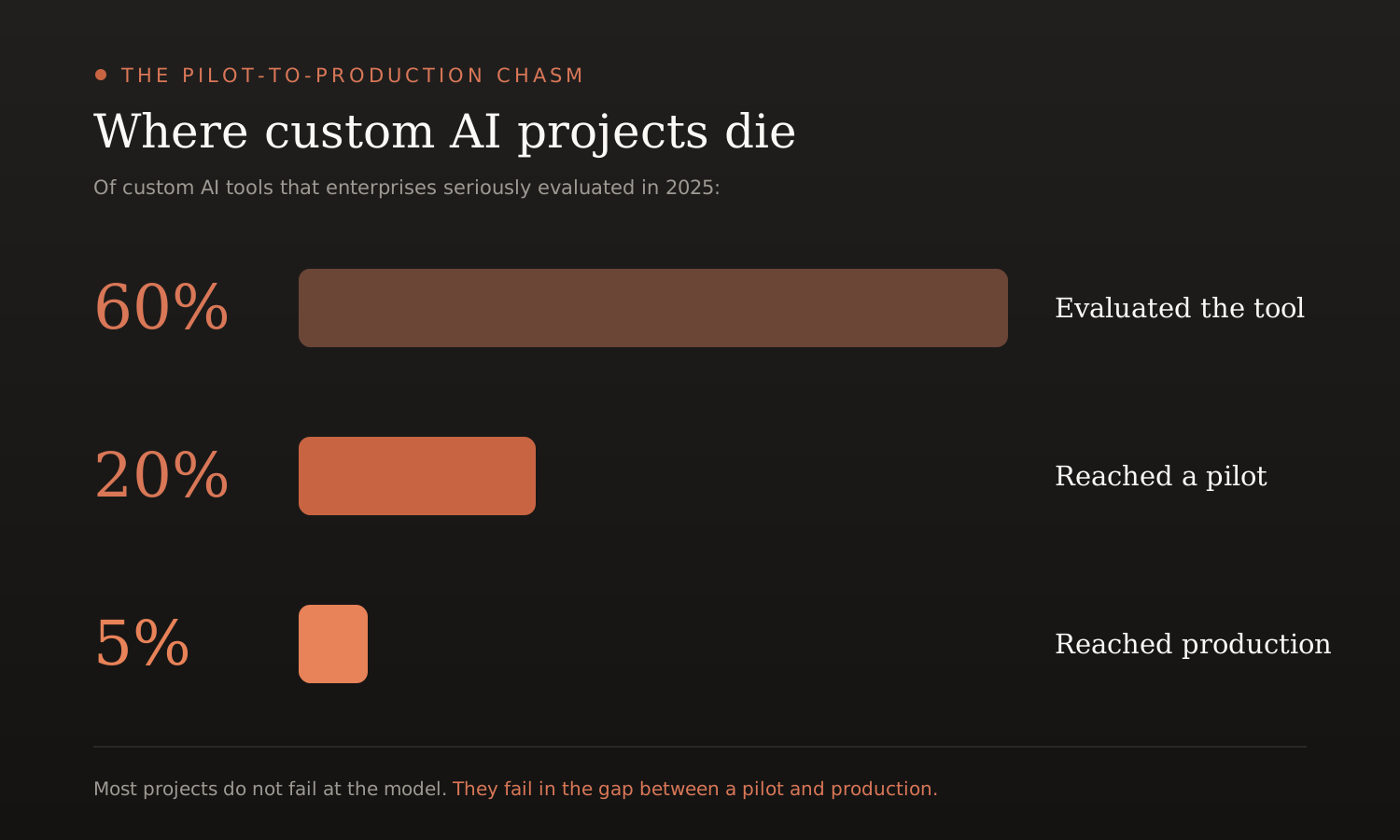
What lives in that gap is the unglamorous part of the work: evaluation suites that catch a quality regression before users do, error handling for every external dependency, monitoring that watches answer quality and cost rather than just uptime, the integrations into tools people already use, and a staged rollout instead of a big-bang launch. A prototype that impressed the room is not the product. It is the cover of the product.
Failure mode four: bolting AI onto a broken process
McKinsey tested 25 organisational factors against whether companies actually saw profit from generative AI. The single biggest factor was whether they had redesigned their workflows around the AI — and only about 21% had. Nearly four in five were layering AI on top of processes they never rethought.
This is the failure that looks like success right until it is not. The AI works. But the process it joined still has the same handoffs, the same bottlenecks, the same manual steps on either side — so the model made one link of a chain faster, and the chain was never the problem. AI bolted onto a broken process just gives you a faster broken process.
Almost no AI project fails because the AI could not do it. It fails because nobody engineered the project — the problem, the data, the workflow — around it.
Build it yourself, or bring in a specialist?
One more finding is worth knowing, because it runs against instinct. MIT found that AI projects delivered with a specialised outside partner reached production roughly twice as often as projects built entirely in-house — about 67% against 33%. The honest caveat, which MIT makes itself: that is a correlation from a modest sample, not proven cause. Companies that hire well may simply run projects well.
But the mechanism is plausible. A specialist has met the failure modes above before, on someone else’s budget, and designs around them from day one. An internal team building its first AI system discovers those lessons in production — which is the most expensive possible place to learn them. Just be sure the specialist is genuinely one: not every vendor selling “AI” is what they claim.
How to de-risk yours before you spend
Almost every failure mode above is a decision made early, while it is still free to change. Here is the checklist that keeps a project out of the failed majority.
- Start with a costed problem. One specific process, one number it is costing you — written down, and agreed by the business and the engineers in the same words.
- Audit the data first. If the data the AI needs is messy, siloed, or missing, that is project one. Assume it needs work and budget for it.
- Define success before any code. The number that must move, by how much, by when. An undefined target guarantees an “unclear value” verdict later.
- Redesign the workflow, not just the step. Ask what the process should look like if the AI exists — then build that, not a faster version of the old mess.
- Budget for production, not the demo. Evaluations, monitoring, error handling, integration, a staged rollout. Treat “it works in a demo” as the start of due diligence, not the end.
- Scope it small and prove it fast. A narrow pilot with a real path to production beats a broad, everything-at-once programme.
- Set realistic expectations. The most common failure in Gartner’s 2026 survey was expecting too much, too fast. Plan to iterate.
Where a free audit comes in
Every decision on that checklist gets made in the first couple of weeks of a project — before a line of code exists, while changing course still costs nothing. That is the entire reason Zaibex starts every engagement with a free discovery call and a free AI audit. We look hard at the problem, the data, and the workflow, and we tell you honestly whether there is a project worth doing, what would make it fail, and what it would take to land in the five percent rather than the ninety-five. The cheapest moment to de-risk an AI project is before it has a budget. The audit costs you nothing. Being in the failed majority costs you the whole build.
