
RAG vs a regular chatbot: why your AI keeps giving wrong answers
Why your AI chatbot gives confident wrong answers — and how RAG fixes it by grounding every reply in your own documents. A plain-English guide.

You deployed an AI chatbot. It is articulate, fast, friendly — and every so often it states, with total confidence, something about your business that is simply not true. A policy you do not have. A price that does not exist. A promise you never made. If that is happening, the model is almost certainly not the problem. Nothing is connecting it to your facts.
Why a chatbot gets your own facts wrong
It helps to understand that this is not a malfunction. It is the design. A language model is trained on an enormous amount of public text, and then frozen at a cut-off date. Three things follow from that, and each one produces wrong answers.
- It does not know anything recent. Every model has a training cut-off — a date after which it has seen nothing at all. Last quarter’s price change is invisible to it.
- It has never seen your business. Your policies, your contracts, your product catalogue, your support history were never in its training data. On a question about them, it has nothing to recall.
- It is built to always answer. A language model predicts the next likely word; it is not built to say “I don’t have that.” A confident wrong answer and a confident right answer come out of the exact same machinery.
So when a customer asks something specific, a plain chatbot does the only thing it can — it generates the most plausible-sounding sentence it can assemble. Plausible is not the same as correct, and the model genuinely cannot tell the two apart.
How often does this actually happen?
Often enough to matter. A Stanford study tested commercial legal-research AI tools — products built and sold specifically for accuracy — and found they still produced incorrect or misleading answers on between 17% and 33% of queries. A peer-reviewed medical study found a leading general model hallucinated on 53% of clinical questions with no safeguards in place. On easy tasks the best models sit at a couple of percent; on hard, domain-specific questions, double digits is normal. The rate is not fixed — but it is never zero, and the wrong answers arrive in exactly the same confident voice as the right ones.
What RAG actually is
RAG — retrieval-augmented generation — is the standard fix, and the idea is simpler than the acronym. The plain-English version: instead of answering from memory, the system is given a library card. Before the model replies, it looks the answer up.
Mechanically: a question comes in, the system searches a private collection of your documents — your handbook, your policies, your catalogue, your past tickets — for the passages most relevant to that question, and places those passages into the prompt alongside the question. The model is no longer answering from memory. It is answering from your facts, set in front of it a moment before it responds.
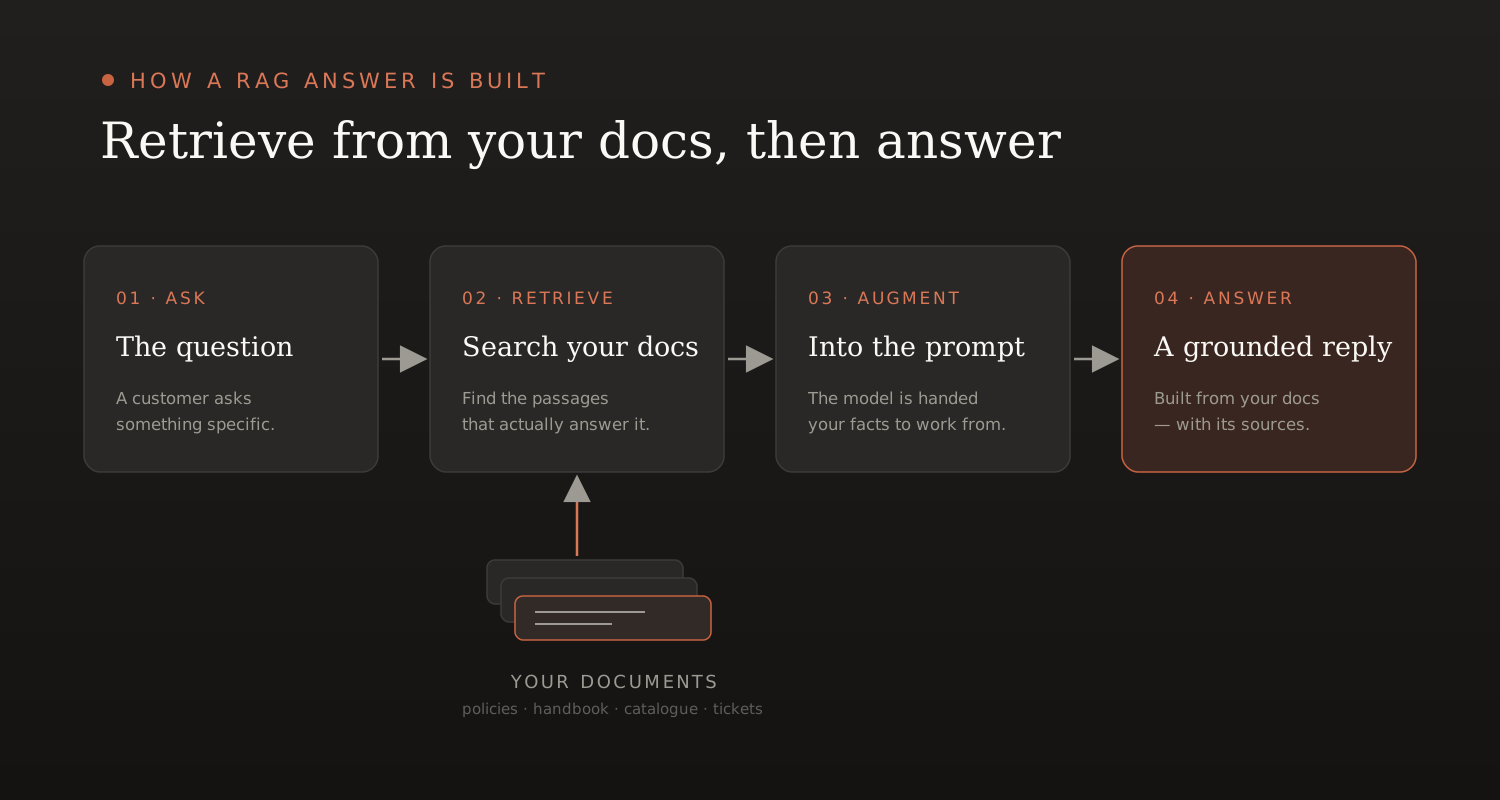
The idea is not new — it was named in a 2020 research paper from Meta’s AI lab — but in 2026 it is the default architecture for any serious business AI. And it brings two consequences that matter to you specifically. The answer can cite its sources, so a person can check the receipt. And when something is wrong, you fix it by editing a document — not by retraining an AI.
Why this fixes the wrong-answer problem
Grounding a model in retrieved, relevant material is the single most effective lever there is on accuracy for company-specific questions. Independent tests put the reduction in fabricated answers from good retrieval at roughly half — and honestly, the precise percentage matters less than two things it changes.
First, the model stops guessing, because it no longer has to: the answer is sitting in front of it. Second — and this is the part teams underrate — the remaining errors become detectable. An answer that cites its sources can be checked in seconds. An answer with no sources can only be trusted, or not. RAG does not just make your AI more right. It makes it auditable.
If your AI cannot say “I don’t know,” it is not retrieving your facts. It is improvising — and improvisation is where wrong answers come from.
Demo RAG and production RAG are different systems
Here is the catch, and it is the reason this is an engineering article and not a tutorial. Wiring up basic retrieval takes an afternoon and demos beautifully. Then real users arrive — with questions phrased badly, questions that span three documents, questions quietly out of scope — and the afternoon version starts missing. Practitioners estimate that the large majority of RAG failures trace not to the model but to the retrieval layer underneath it. The honest proof: that Stanford study was testing shipping commercial RAG products. RAG built carelessly still gets a third of answers wrong — one more version of the reason most AI projects fail: the demo was never the hard part.
What separates the two
Three pieces of engineering stand between a demo and a system you can put in front of customers.
- Chunking. Documents have to be cut into passages before they can be searched. Cut them too small and an answer loses the context that made it correct; too large and the relevant sentence drowns in noise. Chunking is a retrieval decision tuned against real questions — not a default copied from a tutorial. Teams have moved accuracy by double digits on this alone.
- Hybrid retrieval. Pure meaning-based search quietly misses exact terms — a product code, a clause number, a person’s name. Pairing it with old-fashioned keyword search recovers the precise matches a meaning-based index drops on the floor. It is now the default first stage of any serious system.
- Reranking and evaluation. A second pass re-sorts the retrieved passages so the most relevant reach the model first — repeatedly the single highest-return improvement teams make. And a graded set of real questions, run on every change, turns answer quality into a number you can watch, so a regression shows up on a dashboard rather than in a customer complaint three weeks later.
None of this is exotic. It is simply the difference between something that worked in a meeting and something that holds up on a Tuesday. In early 2025, fewer than a third of RAG projects were built with proper evaluation. By 2026 it is closer to two-thirds — the field has learned, the hard way, exactly where the afternoon prototype breaks.
When RAG is the right tool — and when it is not
RAG is the right tool whenever the AI needs to answer from a body of knowledge that is yours and that changes: support and policy questions, an internal assistant over your handbooks and processes, a sales assistant over a live catalogue — anything where the answer must be current and checkable.
It is not a fix for everything. If the problem is that the AI does not sound like your brand, or does not format things your way, that is a behaviour problem — fine-tuning territory, not retrieval. If the task is pure reasoning or writing with no facts to look up, retrieval adds nothing. And if your entire knowledge base is a handful of pages that never change, you can simply put them in the prompt. RAG earns its keep when the knowledge is yours, sizeable, and moving.
How Zaibex builds it
We build retrieval systems the production way — chunking tuned to your actual documents, hybrid search, a reranking pass, citations on every answer, and an evaluation set that catches a regression before your customers do. If you already have a chatbot that is confidently wrong, the free audit is the place to start: we look at where it is failing, and tell you honestly whether retrieval fixes it and what that would take. A chatbot that answers from your facts and shows its sources is a different product from one that simply guesses well.
