How to hire a developer to build your AI coach: questions to ask any studio (2026)
Before you hire anyone to build your AI coach, ask who will own the code and the AI accounts, what the price covers, how your method gets into the AI, and what happens after launch. Here are the questions, what a good answer sounds like, and the red flags.


The developer stopped answering in March.
Say you run a sales coaching company. Call her Leah. She is made up, but the trap she walks into is real.
Her AI coach worked, and her members used it. Then the person who built it went quiet. She asked for the code and found out what her contract never said.
Here is the short answer before the story ends. Before you hire anyone, ask four things.
Who will own the code and the AI accounts? What does the price cover, in writing? How will your method get into the AI? And what happens after launch, with or without them?
Most studios will answer the price question well. The other three are where the good ones stand out.
Paying for the code does not mean you own it
This is the surprise in Leah’s story. Under US copyright law, the person who writes software usually owns it, even when someone else paid for it.
The US Copyright Office explains the rule in its circular on works made for hire. Work from an independent contractor counts as yours automatically only in nine listed categories, and only with a signed agreement. Software usually is not on that list. So the safe route is a written assignment of copyright to you.
Leah’s contract said what the developer would build and what she would pay. It said nothing about who owned the result.
That one missing line cost her the code.
Accounts matter just as much. If your developer runs your coach on their own OpenAI or Anthropic account, the developer is the AI company’s customer. Not you. I went through what each provider’s terms say in who owns your AI coach.

Questions that protect what you own
Ask these first. A studio that hesitates here will hesitate later, when it matters more.
- Does the contract assign the copyright in the code to me, in writing?
- Will the code live in a repository in my name from the first week?
- Will the AI, hosting and database accounts be opened in my name, with my card on file?
- Can I export every conversation and every member record, in a format another tool can read?
- Do you reuse a platform you own underneath my coach? If so, what happens to my coach if I stop paying you?
A good answer is boring: yes, it is in the contract, and the accounts are yours from day one. A red flag is any version of “we host everything for you, so you don’t have to worry about it”. That sentence describes a rental.
Questions that protect your budget
The build price is the number everyone asks about. It is rarely the one that grows.
Leah has 120 members. Her build is paid once. The AI bill arrives every month and rises with every member who uses the coach.
In my own estimates, text practice runs about $0.50 to $1 per active member a month, and voice about $2 to $4. The math is in how much an AI coach costs.
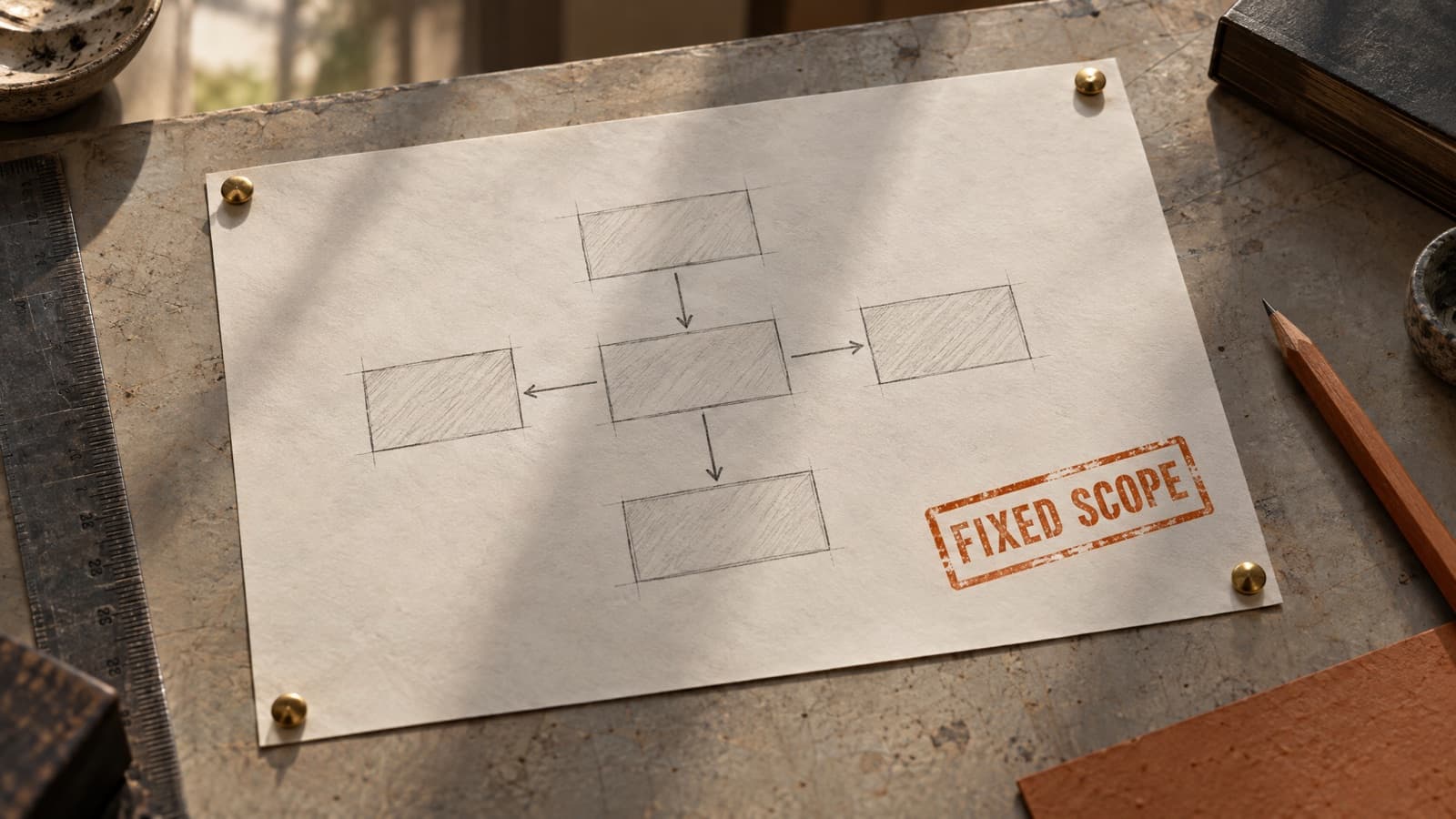
- Is this a fixed price for a fixed scope, or an hourly estimate?
- What exactly is in the scope, and what counts as a change?
- What will the AI and hosting bill be per active member a month, and whose card pays it?
- Do you add a markup to that bill?
- Do you charge per seat, or take a share of my revenue?
- How long are fixes covered after launch, and what does support cost after that?
A good answer puts the scope on one page and the running cost per member next to it. Two red flags matter most. A per-seat fee grows with your success. A revenue share does the same, forever.
Questions that protect your method
Your method is the product. A coach that sounds smart but teaches someone else’s method is worse than no coach at all.
So ask how your method gets in. Leah has a six-step sales framework, a scoring sheet her coaches use, and three years of answers to the same ten questions. A good studio asks for all three before it quotes.
- What do you need from me before you can quote: my exercises, my rubric (the scoring sheet), my past answers?
- What does the coach do when a member asks something my material doesn’t cover?
- Can I run test conversations and correct the answers before any member sees it?
- How will I know, week to week, whether it is teaching my method well?
The second question is the best test. A good answer is “it says it doesn’t know and sends the question to you”. A bad one is “it will always have an answer”. An AI that always has an answer will sometimes make one up.
Questions that protect your people
Your members will tell an AI coach things they would not post in your community. Ask how the studio handles that before your name is on it.
- Does it tell members it is an AI, every time?
- What happens if a member writes something that sounds like a crisis?
- Does it stay out of medical, legal and tax advice, even when my niche sits close to them?
- Can one member, or a coach who doesn’t work with them, ever see another member’s answers?
- Does it stop messaging someone who asks it to stop?
For the crisis question, a good answer is specific. It points the member to the 988 Suicide & Crisis Lifeline and tells you straight away. A vague answer means nobody has thought about it yet.
Questions that protect you after launch
Every build breaks somewhere in its first months. A platform changes its API, or a model gets retired. The question is who fixes it, and what it costs you.
- If you disappeared tomorrow, could another developer run this next week?
- Will I get written notes on how it is built and how to deploy it?
- Which outside services does it depend on, and what happens if one changes its prices?
- Does anything switch off if I stop paying you?
The first question is the one I would ask if I could ask only one. A studio that has built for handover answers it in a sentence.
Meet the person who will write the code
At some studios, the person who sells the project isn’t the person who builds it. That is fine, as long as you know it. Ask who writes the code, and ask to talk to them before you sign.
Then ask to see something live. A demo video is a promise. A working product you can click through, with a client you can contact, is evidence. Reviews on a third-party site such as Clutch, where the reviewer is verified, are the next best thing.
What would have saved Leah
Back to March. Leah’s coach still runs on the developer’s server and his OpenAI account. She can’t change a line of it, and she can’t move it.
Three things would have saved her. One sentence in the contract assigning her the copyright. A code repository in her name. And AI and hosting accounts opened with her card, so the bills and the keys were hers from the first day.
Ask for all three before you sign. If a studio says no to any of them, ask why, and get the answer in writing.
Ask who owns it before you ask what it costs.
How we answer these questions
Here are our own answers, so you can hold us to the same list. The AI and hosting accounts are in your name, so you pay those providers directly. You get the full source code.
Ask us for the copyright assignment in writing, as you would with any studio. There are no seat fees and no revenue share.
Every build gets one fixed quote in writing after a free call and a free audit. It covers design, build, launch and 60 days of fixes. After that, monthly support is optional, and nothing switches off if you skip it. A first version takes about two weeks, and most builds go live in four to six.
I lead every build and take the first call myself.
We built the full ResultPal platform for author Dr. Pelè. He sells it to organizations. Its AI coach helps people use his teaching. It was in production in about three months.
If you want to put these questions to us, book the free call. What we build for coaching businesses is on our AI practice coach page, and the price side is in how much an AI coach costs.
Sources
- US Copyright Office, Circular 30, Works Made for Hire: https://www.copyright.gov/circs/circ30.pdf
- 17 U.S.C. 101, definition of a work made for hire: https://www.law.cornell.edu/uscode/text/17/101
- 988 Suicide & Crisis Lifeline: https://988lifeline.org/
- Clutch, Zaibex profile: https://clutch.co/profile/zaibex